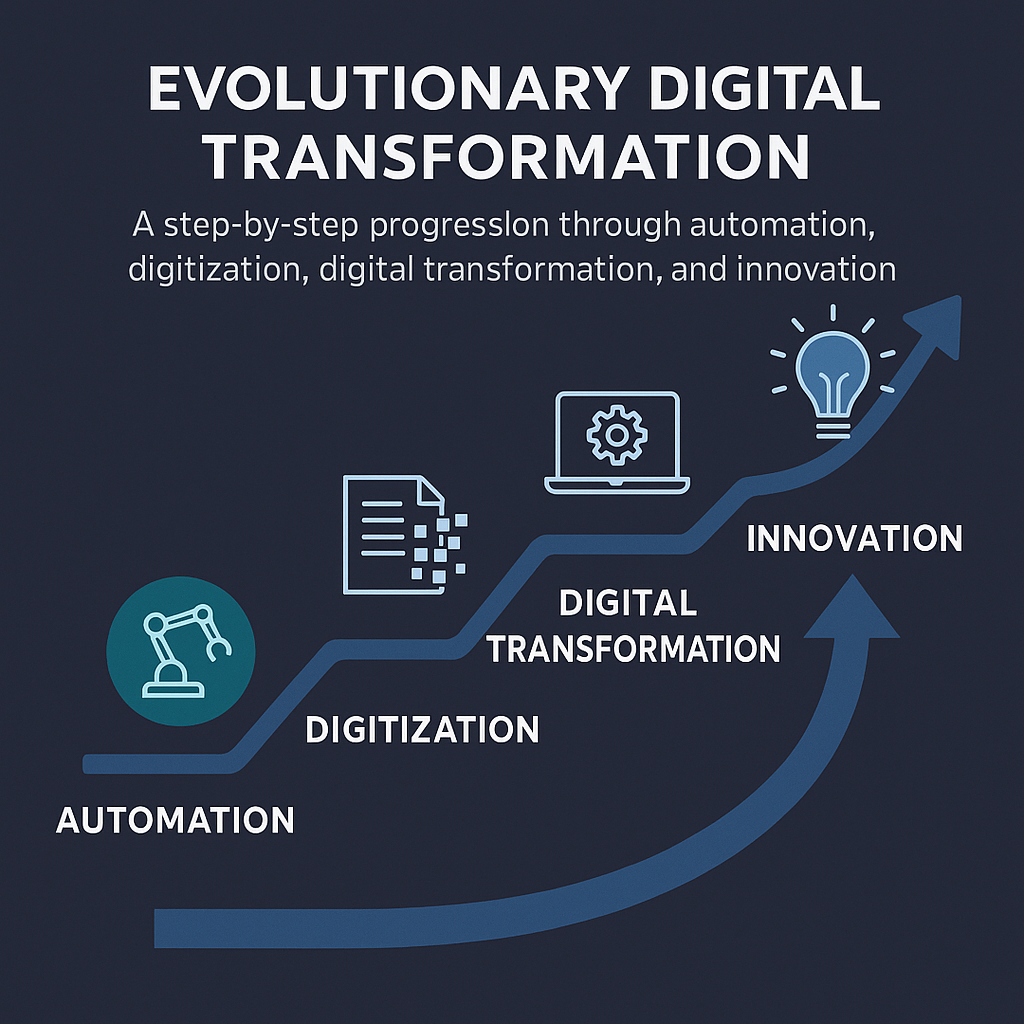
Many companies believe that Digital Transformation requires a Digital Revolution—a radical disruption involving sudden changes in technology, processes, and culture. However, in practice, true transformation happens gradually, sustainably, and continuously, process by process, through incremental improvements.
The idea that businesses must “scrap everything and start from scratch” is a dangerous myth. Large, abrupt changes can lead to internal resistance, high costs, and operational risks. Instead, the most efficient path is digital evolution: modernizing systems, automating repetitive tasks, and integrating smart tools—all with a clear purpose and well-defined metrics.
In this article, we’ll explore why Digital Transformation is an evolutionary process, how to implement it strategically, and how Power Platform and a .NET Software Factory can accelerate this journey without requiring a revolution.
1. Why is Digital Transformation an Evolutionary Process?
1.1. Minimizes Risks and Increases Adoption
Digital revolutions often face resistance because:
- Sudden changes intimidate employees, who may feel overwhelmed or fear job loss due to automation.
- Legacy systems have critical dependencies that can’t be replaced overnight.
- Failures in disruptive projects can halt operations and lead to significant losses.
An evolutionary approach reduces these risks by:
✔ Introducing changes in stages, allowing testing and adjustments.
✔ Prioritizing high-impact processes (e.g., report automation, data integration) before complex migrations.
✔ Involving end-users in the process, increasing acceptance and identifying real needs.
1.2. Enables Continuous Adjustments Based on Data
A radical transformation often follows a rigid plan with little room for corrections. An evolutionary digital approach allows:
- Real-time monitoring of results (e.g., with Power BI) and strategy adjustments.
- Scaling only what works, avoiding investments in low-return solutions.
- Incorporating feedback from operational teams, ensuring tools solve real problems.
1.3. Aligns Technology, Processes, and People
Digital Transformation isn’t just about technology—it’s about cultural change. A gradual approach enables:
- Employee training on new tools (e.g., Power Apps, Power Automate) without overwhelming them.
- Integration of legacy systems with modern solutions (via .NET Software Factory) rather than abrupt replacements.
- A continuous improvement mindset, where small innovations are celebrated and replicated.

2. How to Implement an Evolutionary Digital Transformation?
2.1. Start with High-Impact, Critical Processes
Identify areas where small changes deliver big results:
- Automate manual reports → Power BI + Power Automate.
- Digitize paper forms → Power Apps + SharePoint.
- Integrate disconnected systems → Azure Integration Services + .NET.
2.2. Adopt Low-Code to Accelerate Solutions
The Power Platform lets business units build their own solutions without heavy IT reliance:
- Power Apps → Custom apps in days, not months.
- Power Automate → Workflow automation across systems.
- Power Virtual Agents → Chatbots for internal and external support.
2.3. Use a .NET Software Factory for Scalability
While low-code solves agile demands, a .NET Software Factory ensures:
- Robust, scalable systems for complex processes.
- Secure integration with ERPs and legacy databases.
- Standardized development, reducing costs and delivery time.
3. Conclusion: Evolution > Revolution
Digital Transformation doesn’t need to be a revolution—and in most cases, it shouldn’t be. Companies that adopt an evolutionary approach:
✅ Reduce risks and increase internal adoption.
✅ Optimize costs by focusing first on critical processes.
✅ Build a culture of continuous innovation, where each improvement paves the way for the next.
If your business seeks modernization without disruption, combining Power Platform (for agility) and a .NET Software Factory (for robustness) is the ideal path.
Ready to start your evolutionary Digital Transformation journey? Consult with experts and discover how to begin with quick, high-impact projects!
🔗 #DigitalTransformation #PowerPlatform #SoftwareFactory #DotNET #LowCode #Automation #DigitalEvolution #AI